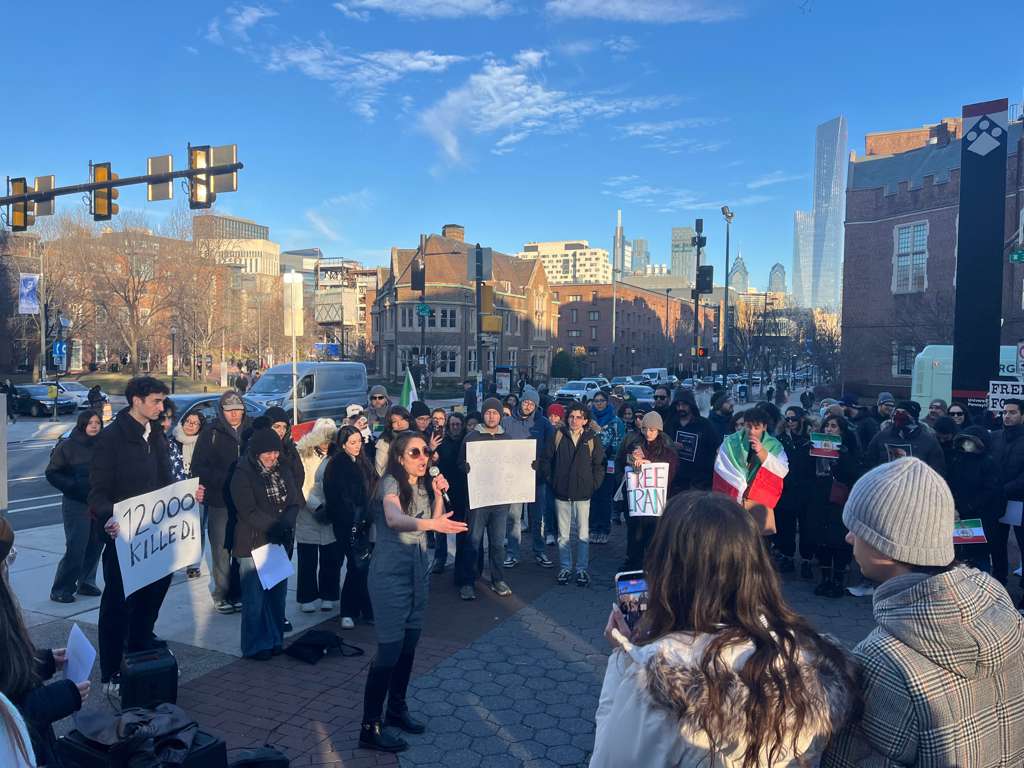
In light of recent uprisings in Iran, Penn students gather to protest against the regime.
Photo Credit: Abraham Franchetti
By: Abraham Franchetti
Around 75 to 100 people rallied at 34th and Walnut on January 16th 2026, calling for the end of the Ayatollah’s regime in Iran and for violence against protestors to cease. The rally was organized by the Penn Persian Society following several days of anti-government protests in Iran, met with the state’s use of force. A communications blackout imposed by the Iranian government has limited contact with people inside the country, and casualty estimates range from 12,000 to 20,000 people.
Penn Persian Society President Adrian Rafizadeh (Wharton ’26) spoke about his experience as a second-generation Iranian-American, emphasizing the privilege of being born in a free country and his responsibility to support protesters in Iran.:
“Ethnically, I am no different from any 23-year-old marching in the streets right now. I am no different from the millions marching in the streets right now. I am no different from the thousands who have been shot and killed” he said.
Rafizadeh organized the rally to raise awareness amongst Penn students about the tragedy and bring further United States’ pressure on the regime. In a statement to The Pennsylvania Post he called on Penn students “…to treat this crisis with the gravity and notoriety it deserves. Today, thousands of unarmed protestors are being gunned down in Iran. Never mind even that for the past 47 years the Islamic Republic has terrorized a beautiful country, but just the acute humanitarian disaster right now should be enough that everyone should be talking about it. Everyone should be demanding action from the American government to stop the killing and free Iran and the world from this evil terrorist regime.”
Sana Dezhabad, a junior at Penn, stated that President Trump should act on his threat that U.S. intervention would follow if protesters were killed by the Iranian government. She stated:
“Why should the US get involved? First: Weakness invites danger. When the U.S. hesitates it doesn’t create peace, it creates a vacuum, and the vacuum is filled with authoritarian regimes like the Islamic Republic. The Islamic Republic doesn’t interpret this as diplomacy, they interpret this as permission to do their heinous acts.” She continued“Secondly, US involvement strengthens global stability. The Islamic Republic doesn’t threaten only Iranians, it fuels regional militias, [such as] Hamas, Hezbollah, they sent Shahed missiles to Ukraine to kill civilians there… standing up to this regime is not about starting a war, it is about deterrence.”
Dezhabad said that failing to stand up to Iran on threats would serve a greenlight for other dictators and American adversaries. Rather than an invasion she urged “strategic action” to support the Iranian people and weaken their oppressors.
In between speeches, protesters chanted opposition slogans such as“Woman, life, freedom,” “Free Iran,” “IRGC terrorists.” Some members of the crowd also held portraits of Reza Pahlavi, the exiled crown prince, whom many opponents of the clerical regime view as a potential leader of a post-ayatollah Iran.
Dr. Fatemeh Shams, associate Professor of Persian Literature at Penn, spoke in support of the protestors and called on those who care about human rights to support them. In particular, she called on academics who have been active in support of other humanitarian causes to treat Iran with equal importance. She said in an interview with the Atlantic that a lack of support from academics had left her feeling “isolated and betrayed.”
Such sentiments were reflected by several speakers who also pushed back against claims that opposition to the regime is driven by foreign governments.
Amin, a freshman from Iran, discussed the importance of distinguishing the Iranian people from their government. He called on the US to accept visa applications from Iranians and take more action to target the government rather than ordinary Iranians.
The following speaker, Dr. Golkoo Hosseini, a physician and Professor of Psychiatry at Penn, gave an impassioned appeal for people to recognize the gravity of the violence unfolding in Iran, particularly against women. She also called for communications to be restored so that families could reconnect and find loved ones.
Rafizadeh closed the event by leading chants of “Free Iran,” and emphasized that this fight will continue until the regime is overthrown.
Abraham Franchetti is a senior in Wharton studying Finance with a minor in Classical Studies from Port Washington, NY. Abraham is President Emeritus of the Wharton Management Club and the Business Director for The Pennsylvania Post. His email is abrahamfranchetti@gmail.com