California billionaires can run, but they may not be able to hide.
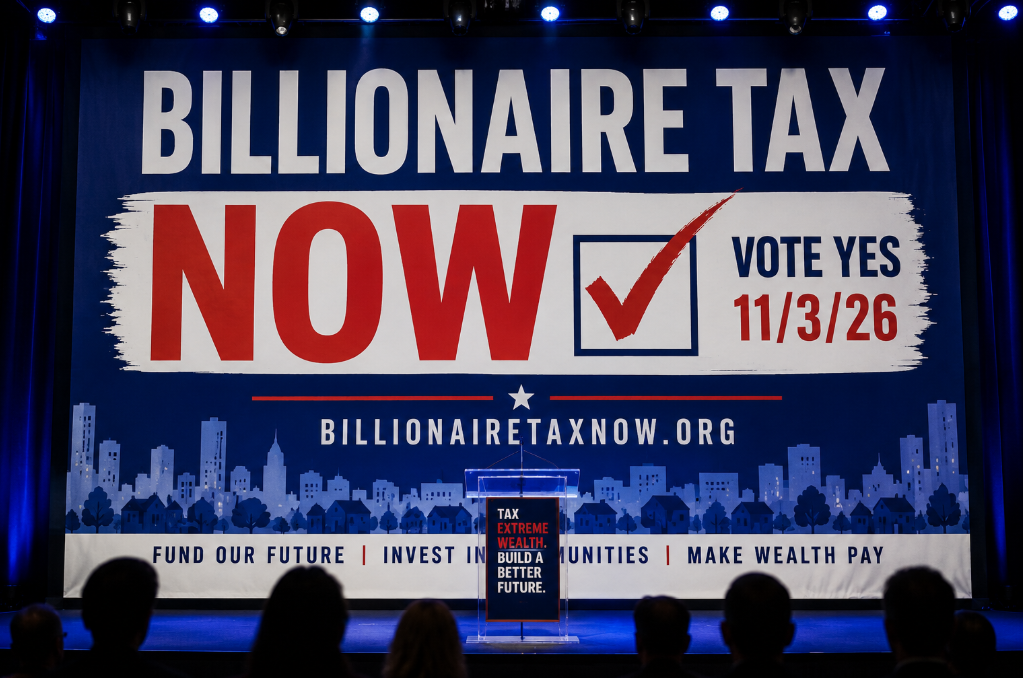
Photo Credit: CaBillionaireTax.org
By: Sara Carr
In recent years, the progressive left has aggressively framed wealth as exploitative and redistribution as the solution. This ideology has found a secure home in the Democratic Party, largely under the banner of “Democratic Socialism” championed by Bernie Sanders, Alexandria Ocasio-Cortez, and most recently Zohran Mamdani.
This progressive wing might be gaining momentum with Mamdani’s New York City mayoral victory, but its economic ideology is radical. The latest example is the California Billionaire Tax Act, a retroactive wealth tax on billionaires residing in California as of January 1, 2026.
The Democrats’ divide over the California wealth tax is emblematic of the broader fight for control within the Party: the more moderate establishment versus the far-left Mamdani progressives. The radical idea of a wealth tax in California is not unprecedented; it has emerged from an economically disastrous school of thought pushed by the progressive wing. While the Democrats battle internally, Republicans have a unique opportunity to present their economic philosophy as a clear, sane alternative.
In late 2025, the Service Employees International Union-United Healthcare Workers West (SEIU-UHW) crafted the California wealth tax proposal, which calls for a one-time 5% tax on wealth for the state’s approximately two hundred billionaires. SEIU-UHW estimates approximately $100 billion in tax revenue from the act, which would primarily be used to offset the funding loss from the One Big Beautiful Bill to support California’s healthcare costs. Proponents need to collect approximately 875,000 signatures by June for the initiative to qualify for the November 2026 ballot.
Supporters— from the same faction that chants “Tax the rich!” at Mamdani rallies— unsurprisingly believe it’s the billionaires’ job to fill the healthcare funding gap (The Editors). The top 1% of California income earners pay 39% of state income taxes, with an average tax rate of 27% (vs the state’s broader 16%), according to Nasdaq. Regardless of who is paying a widely disproportionate amount of California taxes; the progressive flank never passes up an opportunity to make top earners pay more.
The progressives argue that while billionaires won’t feel the impact of such a tax, it would create more equitable outcomes for poor Californians who benefit most from the tax revenue. But from the New Deal to the Great Society, entitlement expansions have promised to make the country a better place but have resulted in a bloated, centralized government with little economic benefit. The Mamdani wing solution? Go even further.
Wealth taxes are not a new concept for the progressive wing. In 2020, presidential candidates Elizabeth Warren and Bernie Sanders campaigned on implementing a federal one. Sanders has openly supported the California bill, according to Fortune. While Mamdani, Warren, and Ocasio-Cortez have not publicly commented on the proposal, their longstanding anti-billionaire stance is a defining part of their political identity, making their support for the measure all but certain.
However, the more moderate establishment wing of the Party is fighting the proposal. In a rare moment of economic clarity, California Governor Gavin Newsom publicly opposed the bill, along with four of the eight key gubernatorial candidates in the state. Likely playing moderate ahead of his assumed 2028 Presidential campaign, Newsom noted at the New York Times DealBook Summit, “You can’t isolate yourself from the 49 others. We’re in a competitive environment.”
Progressives underestimate the negative impacts of the California tax initiative. Practically implementing this tax would be challenging. Billionaires often hold most of their wealth in business equity in the form of unrealized gains, not in liquid cash. How will the California Franchise Tax Board (FTB) accurately value this equity wealth, which is often complex and illiquid? If an experienced investment bank finds pinpointing the valuation challenging, the FTB doesn’t stand a chance. Are billionaires forced to sell equity positions to obtain the cash to pay the tax bill? Plus, the incremental administrative resources required to implement the tax would be costly.
Just as with many of the Mamdani wing’s proposals, the California wealth tax would have reckless and harmful economic consequences. High-net-worth individuals would relocate their businesses and employee bases to lower-tax states like Florida and Texas. According to the Los Angeles Times, Peter Thiel (PayPal), David Sacks (venture capitalist), and Larry Page (Google) have reportedly already begun their relocation. An exodus from California would shrink its tax base, deter new investment, and stall economic growth—a pattern already seen following the post-COVID out-migration.
Realistically, the odds that the wealth tax passes appear challenging today, but it does exemplify how radical the progressive left’s economic ideology has become. Sanders and Ocasio-Cortez’s “Fighting Oligarchy Tour” rallies are replete with anti-wealth, anti-corporate rhetoric and call for radical government intervention and aggressive redistribution—despite a century of limited success. Mamdani has even admitted that “the end goal [is] seizing the means of production,” a core tenet of socialism (Politifact).
Beyond the wealth tax, progressives have also proposed impractical increases to the minimum wage, hikes to corporate taxes, free healthcare, public housing construction, city-owned groceries, and free childcare. But just like the wealth tax, these policies are fraught with unintended consequences and impracticalities. The result is an economic vision that undermines free enterprise, penalizes innovation, and punishes economic success while promising more than it can deliver—the opposite of the principles upon which America was built.
The establishment Democrats are pushing back against the progressives in the intra-party fight over who will control the direction of the Party. The establishment wing, though far from free-market oriented, is more moderate and incremental in its approach to policy change. It largely rejects the socialist proposals of the Mamdani types and recognizes the potential ramifications of such radical governance.
However, the current outlook for moderates is grim. The progressive wing has momentum coming out of Mamdani’s New York City mayoral victory—one of the most prominent Democratic Socialists to win an election, let alone in the financial capital of the world.
Voters are resonating with the faction’s messaging as anxieties about affordability and economic inequality rise. Should the establishment lose this fight, the progressives’ vision will not just reshape the Democratic Party, but it will also steer the country further down a socialist path.
But while the Democrats continue their infighting, Republicans have an opportunity to present a stark contrast between economic philosophies—one rooted in the belief that entrepreneurship and risk-taking are the engines of American prosperity. Republicans must stand firm against radical economic proposals that disincentivize risk and hard work, welcome innovative entrepreneurs into their tent, and showcase how free-market governance ultimately drives opportunity and prosperity.
While progressives come up with the newest disastrous economic policy, Republicans must stand as the party of economic sanity—or risk allowing radical policies to reshape the nation.
Sara Carr is a second year MBA student concentrating in Business Economics & Public Policy at Wharton from Birmingham, Alabama. Her email is saracarr@wharton.upenn.edu