When disagreement becomes disqualification, discourse dies.
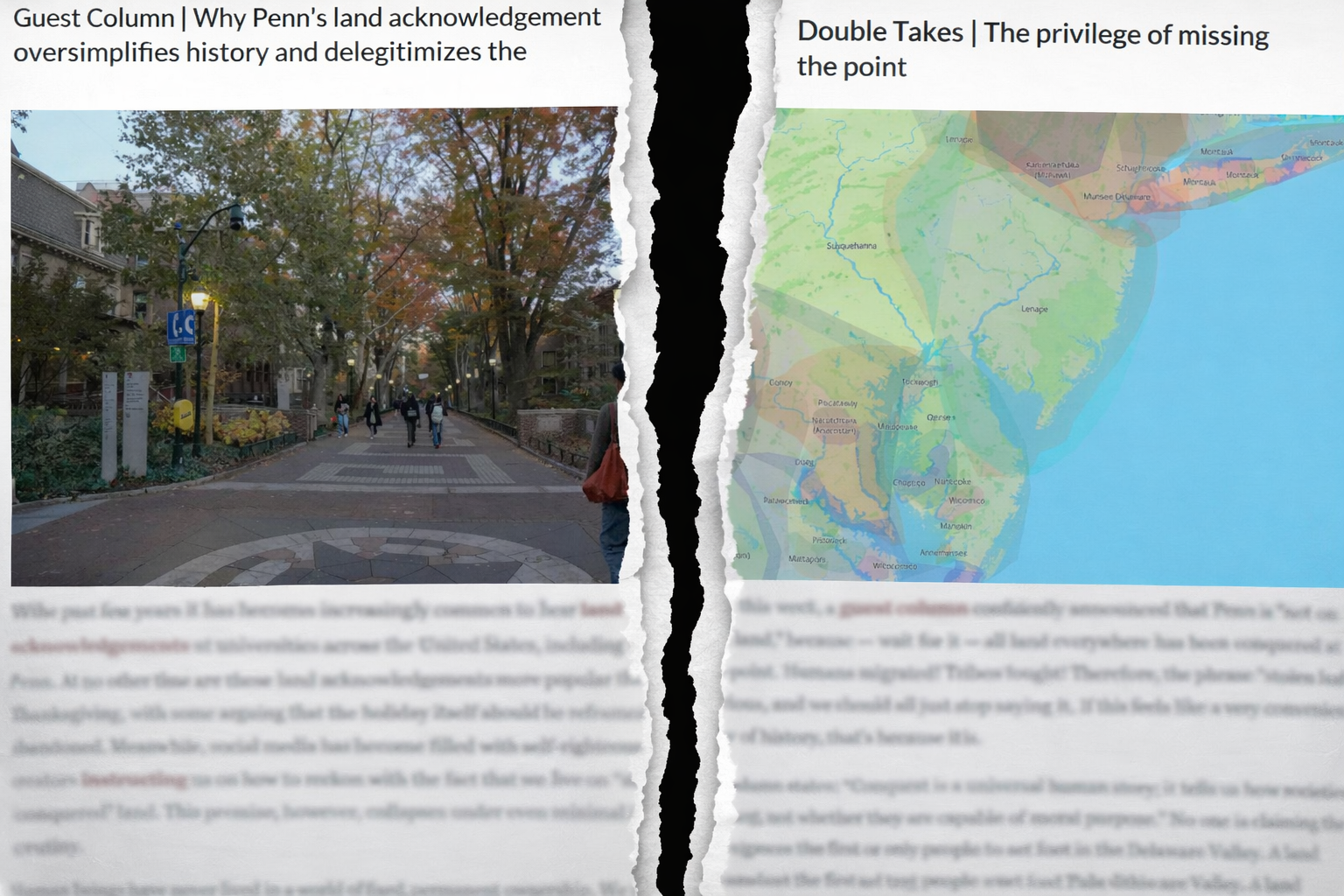
Photo Credit: Jennifer Mesa; the article images used to make the graphic are from the Daily Pennsylvanian
By: Bo Goergen
“Penn is not on stolen land,” I stated in a December article published in the Daily Pennsylvanian. In my article, I argue against the use of land acknowledgements because they imply that one specific ethnic group has a permanent and rightful claim to any land. I acknowledge the profound suffering that European arrival brought upon native tribes, but assert that America’s “legitimacy does not come from undoing its past, but from the principles it enshrines: liberty, equality, and the belief in self-determination…The country’s defining story is not one of genocide, but of an imperfect nation striving to achieve its perfect ideals.”
Once posted on the DP’s website and social media feeds, the article quickly became one of the most read and shared pieces in recent memory, prompting backlash across campus: both positive and negative.
Of the negative responses, only a small portion were thoughtful in any sense of the word. A handful of critics engaged directly with my claims, challenged my reasoning, and offered substantive and reasonable counter arguments. For example, a rebuttal was quickly published in the DP.
However, these productive exchanges were few and far between. The vast majority of negative responses had nothing to do with the validity of my argument. Instead, they took the form of personal insults rooted almost entirely in identity politics. I was told that my race precluded me from having an opinion, rendering any arguments I made invalid. In Instagram comments and anonymous emails, I was reduced to slurs and mockery in an effort to delegitimize my arguments.
More disturbing still than the insults and threats themselves was that certain student groups publicly condemned the DP for publishing my views at all, presumably because they disagree with them. These groups suggest that my argument lacks a “basic level of respect necessary for that discourse to be productive” and therefore should not have been given a platform.
We should all be concerned that many at Penn seem either unwilling or unable to engage intellectually with ideas they oppose. If students at one of the nation’s most prestigious universities cannot respond to controversial arguments without resorting to threats or intimidation, it raises serious questions about the health of intellectual discourse not just at Penn, but across higher education.
It has been well documented that academia has become increasingly liberal since the 1960s. What has changed, however, is the scale of that imbalance. According to the American Enterprise Institute, from the late 1960s through the early 1980s, the ratio of liberal to conservative faculty members hovered between 1.5 and 1.75 to one. By the 2010s that figure ballooned to approximately five to one, representing a dramatic shift in the ideological makeup of university faculties. In a report published last month, the Buckley Institute at Yale found that 82.3% of the faculty are either registered Democrats or actively support Democratic candidates, compared to just 2.3% who are Republican or support Republicans.
Such ideological uniformity has an intellectually corrosive effect. When one set of views dominates a campus, dissent becomes risky, almost irrational. Professors who depart from prevailing views fear professional consequences, such as diminished prospects for tenure. Once, while engaging in a private political conversation with a professor, the professor, after sharing a slightly more conservative viewpoint, not only swore me to secrecy but asked to communicate using their private email.
This dynamic has a direct downstream effect on students, many of whom quickly learn that compliance is much safer than resistance. A study conducted at Northwestern University and the University of Michigan between 2023 and 2025 found that 88% of university students admitted to exaggerating their progressive views in order to succeed socially or academically.
This corrosive mindset is destructive to not only the pursuit of knowledge and truth within our institutions but also to America itself. A culture that discourages honesty and coddles its students will inevitably produce citizens who are risk-averse, conflict-avoidant, and incapable of defending their convictions.
This dynamic was underscored by my recent experience with the DP. After publishing my earlier column on land acknowledgements, the paper declined to run this follow up piece, presumably to avoid further controversy. Though I respect editorial discretion, this decision demonstrates the very issue this column seeks to address.
Free societies depend on open dialogue and genuine discourse. In many universities across the country, including here at Penn, we have created an environment where students and even professors often do not feel comfortable deviating from the dominant ideology. Students frequently choose to fall in line rather than voice their views for fear of social ostracization or academic repercussions.
Unfortunately, this threatens the foundation and purpose of education itself. At Penn, we need to create an environment where students and faculty can engage in real and honest discourse, not a one-sided debate where only a certain group with a certain ideology is given license to speak.
If community members at Penn are no longer saying what they believe, public discourse becomes meaningless. And, ultimately, if you don’t or can’t say what you believe, why say anything at all?
Bo Goergen is a senior in the College studying political history and international relations. His email is rgoergen@sas.upenn.edu.