A nuanced free-market critique of Trump’s protectionist economic agenda
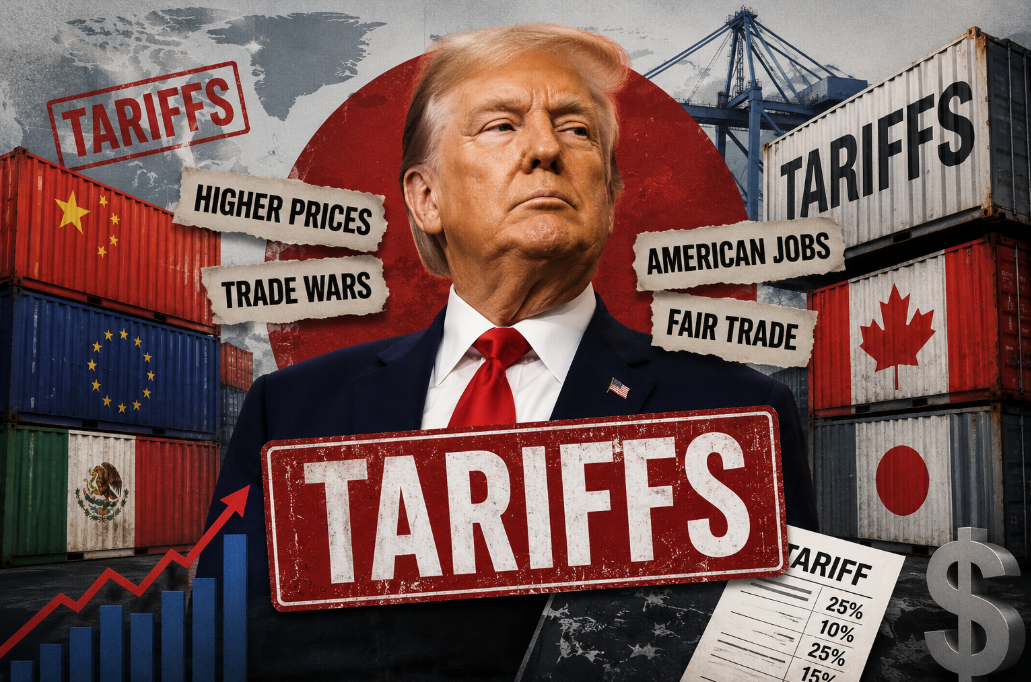
Photo Credit: ChatGPT
By: Sara Carr
“Tariffs are the greatest thing ever invented” (Axios), then Presidential nominee Donald Trump proclaimed at a town hall. Oh no.
The Republican Party, historically an advocate of free-market capitalism, has shifted its stance on tariffs under President Trump. Tariffs—taxes on imports—are used as industrial policy but always bring a host of downstream consequences. Trump followed through on his campaign promise, announcing a new tariff regime on “Liberation Day” in April 2025.
Temporary or targeted tariffs can offer valid benefits. But imposing permanent tariffs and a broader philosophical shift toward protectionism would undermine free-market principles and harm the US economy in the long term.
The Trump Administration has sent mixed messages on whether it views tariffs as a short-term tool or a permanent feature of American economic policy. This debate has become more complicated following the Supreme Court’s recent ruling, which will force Trump to impose his tariffs in more creative ways than under the International Emergency Economic Powers Act.
Beginning in the 1980s, the global economic system largely embraced the Washington Consensus, an economic philosophy of deregulation, privatization, and trade liberalization. Consequently, goods became cheaper, competition encouraged innovation, and living standards improved drastically—the benefits of free-market economics. According to the World Bank, “Economic growth underpinned by better trade practices has lifted more than 1 billion people out of poverty since 1990.”
Yet global trade liberalization has declined since the 2008 Great Financial Crisis, a trend that has accelerated since COVID. The US has recently led this shift under President Trump, who signaled a new direction in American trade policy by declaring sweeping global tariffs on Liberation Day.
While some tariffs have been tempered following trade negotiations, the new regime has “increased the effective tariff rate implied from customs duties from 2.1 percent to an estimated 11.7 percent as of January 2026,” according to Stanford Institute for Economic Policy Research.
Trump’s primary argument for tariffs is that existing trade arrangements constitute unfair practices. In his Liberation Day speech, he claimed, “our country has been looted, pillaged, raped and plundered.” His administration has messaged that US trade deficits are evidence that other nations are cheating America. But trade deficits aren’t inherently bad. They reflect global supply and demand, involving voluntary transactions that benefit each trading party.
This argument also ignores the fact that the US economy has shifted from manufacturing to service industries, in large part due to increased automation. This has resulted in a large services surplus and reflects a higher productivity, more advanced economy. Trump’s solution—using tariffs to reshape production—could push the economy backward and make American services less competitive globally.
Trump also argues that his tariffs will protect domestic industries, bringing manufacturing jobs and prosperity back to middle America. His perspective is grounded in the fact that globalization comes with a tradeoff: it incentivizes domestic production to move to lower-cost countries, negatively impacting manufacturing towns and their economic opportunities.
In 2024, Trump earned outsized support from the working class, many of whom suffered from offshoring and resonated with his promise to reinvigorate their communities. And these communities do need reinvigorating. Having been raised in the middle of the country, I’ve experienced firsthand that these frustrations and struggles are real and need to be addressed.
But the more effective and durable support will come from investments in education, skills-based training, and the revitalization of local institutions, rather than from policies that sacrifice free-enterprise principles or stall economic advancement.
That said, the Trump Administration isn’t all wrong about tariffs. Limited and targeted tariffs can offer strategic benefits that justify their use. The strongest use case for tariffs is to incentivize the reshoring of supply chains for critical national security industries, a vulnerability highlighted during COVID and within the semiconductor industry.
Secondly, tariffs can effectively provide leverage in negotiations with other nations, including when pushing for more free-trade terms with the US or to tighten border enforcement as seen with Mexico.
Lastly, Trump is correct that China is engaging in unfair trade practices, including price dumping, currency manipulation, and intellectual property theft. Therefore, tariffs on China are warranted, particularly if paired with coordination among US trade allies.
Aside from these narrow cases, a broad shift away from a free-market philosophy toward permanent tariffs would carry significant costs.
While the impact of Trump’s 2025 tariffs has not been fully realized due to “shipping lags, exemptions, and enforcement gaps,” US importers and consumers bore approximately 94% of the additional costs in 2025, according to the University of Chicago. If tariffs become permanent, their economic costs will only intensify as they trickle through the economy.
Consumers will bear these costs through higher prices, a politically risky move amid the current affordability crisis. Goldman Sachs estimates current tariffs “will raise inflation by 1 percent between the second half of 2025 and the first half of 2026 relative to its counterfactual path.”
When domestic firms absorb these costs—either as importers paying tariffs directly or as producers facing higher input prices—profit margins compress. This can limit investment and raise the risk of layoffs, undermining the very domestic job growth the tariffs are meant to achieve. Additionally, American exporters are likely to face negative consequences if other countries continue to impose retaliatory tariffs on US goods, making them less attractive to foreign buyers.
There are also, at best, uncertainties about how effective tariffs will be in protecting and promoting domestic industries. These tariffs have yet to bring manufacturing jobs back to the US. According to The Washington Post, “Manufacturing employment has declined every month since Trump declared ‘Liberation Day.’” Based on an AEI report, even if Trump’s April 2025 tariff plan were maintained, manufacturing jobs would rise by only 1%—from 8% to 9% of the workforce—highlighting their limited potential impact.
Many domestic companies have yet to change their behavior in response to the tariffs and remain in wait-and-see mode. For many, it’s still cheaper to source inputs from overseas than onshore. For others, the administration’s back-and-forth on tariff messaging and negotiations has created paralyzing uncertainty, stalling investment or hiring.
Other companies and countries have responded by committing approximately $9.6 trillion in investments to US industry under the Trump White House. However, the tangible benefits remain unclear. Manufacturing plants take years to build—and will face higher input costs due to tariffs—before American jobs are added and production begins. Many of these investments are non-binding, multi-year commitments, raising questions about their durability. These realities suggest that investment commitments are unlikely to deliver the long-term economic revival promised.
The last reason the Trump Administration should not make tariffs a permanent economic feature is that they increase government intervention, picking ‘winners’ and ‘losers’ among industries and undermining free-market efficiency. Trump’s tariff regime is predominantly designed to benefit American manufacturing; however, federal policy should not benefit the 8% of the American workforce employed in manufacturing at the expense of the broader economy and long-term growth.
Granting the federal government this power creates a precedent for politically motivated tariffs in the future. The same manufacturers that cheer tariffs today won’t be too happy if Democrats use them down the road to favor green energy firms over automakers.
The Trump Administration’s long-term tariff policy remains unclear, especially in light of the Supreme Court’s 6-3 ruling in February that the President lacks authority to impose tariffs under the International Emergency Economic Powers Act. But that doesn’t automatically mark a tariff rollback—Trump has made it clear that his administration is exploring other legal avenues to impose tariffs.
Short-term investment headlines following tariff announcements may give Trump a PR win, but they won’t create lasting economic growth, including in middle America. Ultimately, the administration should remember that sustained prosperity comes from policies that embrace free-market principles—the very system that has lifted billions out of poverty globally.
Ironically, Democrats’ opposition to Trump’s tariffs in the name of free markets echoes the Republican playbook of decades past.
Sara Carr is a second year MBA student concentrating in Business Economics & Public Policy at Wharton from Birmingham, Alabama. Her email is saracarr@wharton.upenn.edu