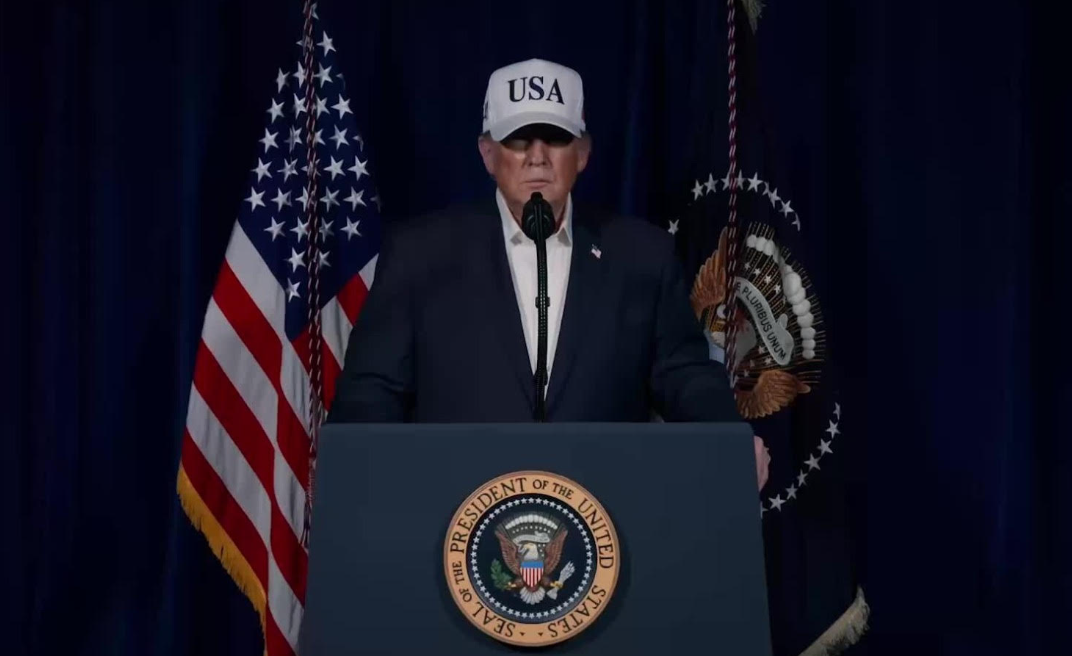
Photo Credit: Donald Trump via Truth Social
By: Anonymous
The next two weeks may determine the fate of the Islamic Republic of Iran. What began on February 28 as Operation Epic Fury, a coordinated US-Israeli strike campaign that killed Supreme Leader Ali Khamenei in the opening hours, has evolved into something far more complex and consequential than either a quick military victory or a prolonged standoff. Iran is not losing a war. It is losing a state. The convergence of forces now closing in on Tehran, ranging from diplomatic to military, economic, and internal, makes a resolution before mid-June not merely possible but increasingly inevitable.
The Beijing Gambit
President Trump departs for his summit with President Xi Jinping in Beijing on May 14-15 carrying what amounts to a diplomatic Hail Mary. The most striking outcome over the last few weeks has been Iranian Foreign Minister Abbas Aragchi’s visits to both Beijing and Moscow, only to come up with standard statements of backing, but no concrete initiative in support of Tehran. As of recently, Washington has been pressing Beijing harder to pressure Tehran into a managed end to the conflict; zero enrichment, a dismantlement of nuclear facilities, and an end to proxy funding in exchange for sanctions relief and a pathway out of the war. The ask is nothing short of enormous. China absorbed over 80 percent of Iran’s shipped oil in 2025, making it Tehran’s economic lifeline, and Beijing has already retaliated against US sanctions on Chinese refineries by purchasing Iranian crude, invoking its anti-foreign-sanctions law for the first time. The base case, as analysts note, is likely “managed détente with thin deliverables,” characterized by vague joint language on de-escalation and a mutual interest in keeping oil flowing. However, Trump is gambling that Xi, who also has a vital interest in a stable Strait of Hormuz, can deliver what no Pakistani mediator has yet managed: a serious concession from Tehran on the nuclear question.
Should Beijing come up empty, and there is every reason to believe it will, given the constraints on Chinese credibility and its parallel confrontation with Washington, the diplomatic window is likely to close and the kinetic phase could resume. The architecture to open the vital shipping passage is already in place. Project Freedom, the operation designed to force the Strait open, was paused after Saudi Arabia restricted U.S. use of Prince Sultan Air Base. It can be restarted. The oil infrastructure on Kharg Island, spared by Trump “for reasons of decency” after the March 13 strikes destroyed over 90 military targets there, remains a credible threat hanging over every session of these negotiations. With West Texas Intermediate (WTI) already above $100 a barrel, Tehran knows what pulling that lever means.
The War Within
Nevertheless, the more decisive battleground may be inside Iran itself. The Islamic Republic today bears an uncomfortable resemblance to Mussolini’s Italian Social Republic, the Salò Republic of 1943 to 1945, a rump ideological state clinging to power in the north, its legitimacy shattered, its military split, its population exhausted, waiting for the final settlement that everyone can see coming but that the hardliners refuse to acknowledge.
The fracture between Iran’s pragmatists and its hardliners is no longer a matter of political positioning. It is a structural rupture playing out in real time. On one side, figures like Parliament Speaker Mohammad Bagher Ghalibaf, who led the first round of US negotiations in Islamabad and has publicly defended diplomacy as a way to “consolidate military gains and translate them into political outcomes,” as well as President Masoud Pezeshkian, are pushing for a negotiated exit. On the other, IRGC commander Ahmad Vahidi and the network around new Supreme Leader Mojtaba Khamenei, elevated hastily after his father’s death in the February strikes, have tightened their grip on every lever of the security apparatus. Vahidi has stated explicitly that under wartime conditions, all critical decisions belong to the Revolutionary Guards. Pezeshkian was forced to accept an IRGC-vetted appointment to the Supreme National Security Council over his own objections. Ghalibaf and Foreign Minister Araghchi, the Al Jazeera dispatch confirms, “cannot make decisions without the IRGC’s approval.”
The consequences of that powerlessness were made visible in a single devastating 24-hour window on April 17th. Araghchi posted publicly that all commercial vessels would be allowed through the Strait of Hormuz for the duration of the ceasefire, with President Trump announcing it as a breakthrough. Global markets rallied. Then the IRGC opened fire on ships attempting to cross, declared the Strait had reverted to strict military control, and the IRGC-affiliated Tasnim news agency publicly rebuked Araghchi’s statement as “a complete lack of tact in information dissemination.” A foreign minister, contradicted and humiliated in real time by his own country’s parallel military, on the question he was supposed to be negotiating. The Institute for the Study of War concluded the obvious: the IRGC, not Iran’s political officials, is controlling Iranian decision-making.
This is not governance. It is hostage-holding. And it is accelerating the system’s internal collapse.
The Artesh Divorce
The most underreported story of this war may be the progressive institutional divorce between Iran’s near 400000-man regular army, the Artesh, and the IRGC. Iran International’s reporting, drawing on informed sources inside the country, has documented a military system under acute strain: frontline units operating with as few as ten rounds of ammunition per soldier, field positions without reliable food or water, and IRGC personnel refusing to transport wounded Artesh soldiers to medical facilities despite having the means to do so. The institutional resentment this has generated, layered over decades of tension between a conventional military that sees itself as a national institution and a Revolutionary Guard that sees itself as the state, has produced what sources describe as mass desertions, with soldiers leaving bases and seeking refuge in nearby towns.
In some provinces, desertion rates have reached figures that would have been unthinkable two years ago. These are not individual acts of cowardice. They are the precursor to an institutional schism, and when the Artesh makes that rupture visible, when it formally distances itself from the IRGC before the eyes of the world and the Iranian population, the regime’s coercive capacity will collapse faster than any airstrike can achieve.
Reza Pahlavi and the Immortal Guard
Into this vacuum steps a figure of enormous symbolic and practical importance. Exiled Crown Prince Reza Pahlavi, who met with President Trump earlier this year, has in recent months activated what he calls the Immortal Guard, a clandestine network of cells operating across Iran, conducting sabotage against the regime’s repressive infrastructure and preparing the ground for what Pahlavi calls “the final call.” His framing is explicit: the Immortal Guard is “born from the people themselves,” playing, for now, a defensive role, protecting civilians and striking the institutions of fear. The parallel to Operation Overlord’s relationship with French resistance networks is not subtle, and it is not accidental. Pahlavi has also confirmed that Trump’s own words about arms flowing to Iranian insurgents were not empty rhetoric. Help, as he told the Guard directly, “has arrived.”
The Gulf’s Hidden Hand
Then there is the revelation that has reconfigured the entire regional picture: the UAE struck Iranian infrastructure following the April ceasefire, targeting the Lavan Island refinery and Sirri Island crude export facilities in what was initially an unclaimed attack. Saudi Arabia, whose Crown Prince has vowed military force against further Iranian incursions and whose airspace was closed to US and Israeli attackers, has also made clear through both action and posture that the Gulf states are no longer passive spectators in this conflict. The UAE received more Iranian missile and drone strikes than any other nation between February 28 and mid-April, 2,819 attacks, and has drawn its own red lines.
The June 14 Horizon
Finally, there is an unofficial deadline forming around the corner. June 11 is the opening of the FIFA World Cup on American soil, an event that Trump has made a signature of his second term. June 14 is the President’s 80th birthday, a date with obvious personal resonance for a man who has never been shy about the theatrical dimensions of his statecraft. Iran faces a decision about its own participation in that World Cup, with the football federation issuing a 10-point ultimatum to FIFA and the US, demanding visa access for delegation members with IRGC ties. The absurdity of that demand, that the United States admit IRGC-linked officials while simultaneously blockading Iranian ports and striking Iranian military sites, underscores how detached the hardliner faction remains from the reality of Iran’s position.
The pragmatists understand the reality. The Artesh soldiers voting with their feet understand it. The workers on Kharg, watching storage units fill with oil that cannot be exported and observing signs of suspected oil slicks while the Strait remains mined, understand it. Iran is where Italy was in the autumn of 1944, the outcome is not in doubt, only the timing and the terms. The Beijing summit is not a pivot point so much as a final courtesy call, an opportunity for a managed resolution before the full weight of external and internal pressure produces something messier and less controllable.
In essence, the Islamic Republic has proven, over 47 years, that it is extraordinarily resilient. However, resilience is not the same as permanence. What is converging on Tehran now; a fractured leadership, a split military, a clandestine resistance, Gulf neighbors who have entered the fight, a US president with a birthday deadline and a World Cup to open, is not a pressure campaign. It is a closing.
The Author is a Guest Columnist who is a rising Senior at Penn studying Finance in Wharton.