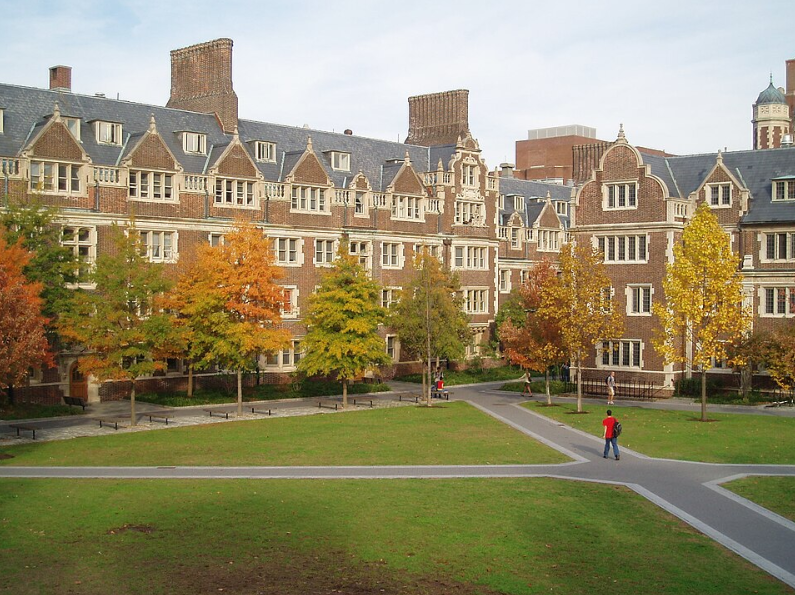
Photo Credit: WikiMedia Commons
By: Abraham Franchetti
Franchetti’s Facts: Penn can’t sell excellence on the brochure and punish it in the classroom.
When the Class of ’26 graduates in a few days, there will be no more “Dean’s List” students at Penn. While it would be a point of pride if that was because the Class of ’26 were uniquely more intellectual than anyone else, the truth is far sadder. In the spring of 2023, after decades of academic recognition, the University of Pennsylvania announced it would cease awarding the Dean’s List.
According to a joint statement emailed to students that spring: “Deans of the undergraduate schools, and representatives from many offices across campus—have concluded that the Dean’s List designation is redundant and does not reflect the breadth of students’ academic achievements.” While no metric is perfect for tracking a student’s academic success, taking away a traditional, merit-based award hardly solves the problem. Rather than trying to reflect the “breadth” of academic achievements, the Dean’s List utilizes concrete metrics: achieving a 3.7 GPA or higher for the year while completing all courses and being in good standing. Unlike Latin Honors, which the undergraduate Deans cited as more important, the Dean’s List gave students something tangible to strive for every semester. This cycle of commending academic achievement each year helps reinforce long-term success through more frequent benchmarks.
Having a Dean’s List that some students complain about not making is a sign of a healthy university, rather than a flaw. Right now, elite education is plagued by a lack of focus on substantive academics. Harvard, long considered “harder to get into than stay in,” awards A’s as 53% of its grades. Their Classroom Social Compact Committee reported that grade inflation allows students to skip readings, not participate in class, and disengage from real learning. Yale’s marquee report on Trust in Higher Education found that alongside political bias and admissions policies, grade inflation is a leading driver of distrust in higher education. In 2022–2023, 73% of grades at Yale were an A or A-. These clusters of high grades make it impossible to accurately evaluate students and their performance. Unfortunately, once these distributions have taken hold, they are difficult to fix. Both reports cite a collective action problem where professors fear that raising standards will cause students to avoid their class when registering. The faculty vote on a Harvard proposal to cap A grades at about 20% has already been postponed until this May due to debate and pushback from faculty and students alike.
Penn is not immune to these pressures. If anything, eliminating the Dean’s List suggests the administration has chosen to join the retreat rather than resist it. When the university strips away one of the few remaining markers of academic distinction, it sends a clear message to students: the bar is coming down, not up. It also undermines the value of a Penn degree. Employers and graduate schools use GPA as a signal precisely because it is supposed to mean something. The more Penn does to obscure or dilute academic performance, the more it erodes the credential it is charging students $90,000 a year to earn.
Eliminating the Dean’s List instead reflects a perverse trend in elite higher education to walk back a commitment to merit in favor of amorphous definitions of achievement. Like so many recent decisions at Penn, this one served to appease underachievers at the expense of the students who earn their recognition. The loudest critics of the Dean’s List were never those on it. Bureaucrats dressed up capitulation as equity, and in doing so, punished the students who pushed themselves to learn.
After completing a grueling college application process, where high schoolers are asked to achieve near-perfect grades, top-percentile SAT scores, and extracurriculars of international acclaim, the Class of ’27 matriculated to learn that no matter how hard they worked, they could not make the Dean’s List. That is not inclusion. That is the administration telling high-achieving students that their effort is inconvenient. Penn recruited them on the promise of rigorous, world-class academics and then quietly removed one of the few formal ways the university acknowledged that they had delivered.
The fix is simple. Reinstate the Dean’s List. Keep the threshold high. Let students compete, fall short, and try again. That is what a serious university looks like, and it is what Penn students deserve
Abraham Franchetti is a senior in Wharton studying Finance with a minor in Classical Studies from Port Washington, NY. Abraham is the Business Director (Emeritus) for The Pennsylvania Post. His email is abrahamfranchetti@gmail.com